
Fire Safety Certificate
This webpage provides an outline of Fire Safety Certificates (FSCs) in the Republic of Ireland, as required under the Building Control Acts and Building Control Regulations.
Fire Safety Certificates
A Fire Safety Certificate (FSC) is a certificate issued by the local Building Control Authority (typically your local County or City Council) that confirms the design of a proposed building, if constructed in accordance with the submitted plans and specifications, will comply with Part B (Fire Safety) of the Second Schedule to the Building Regulations.
Crucially, an FSC certifies the proposed design of the building, not the finished building.
Why is a Fire Safety Certificate needed?
The primary reason for an FSC is to ensure a proposed buildings design meets the required fire
safety standards as set out in the Building Regulations. This is a legal requirement for certain types of
buildings and works to ensure:
-Life Safety: Adequate means of escape in case of fire.
-Containment: Measures to limit the spread of fire both internally and externally.
-Access: Provision of access and facilities for the Fire Service.
Legal Requirements and When to Obtain One
Legal Requirement
The Building Control Act 1990 (as amended) and subsequent Building Control Regulations 1997 (as amended) sets out the criteria where a fire safety certificate is required. It is a statutory breach of Building Control legislation to carry out works until such time as a Fire Safety Certificate has been granted or, in the case of a 7 Day Notice, validated by the Building Control Authority. There are different types of fire safety certificate applications, depending on the situation. These are:
- Standard Fire Safety Certificate: This is a technical submission comprised of a Compliance Report and drawings, submitted to the relevant Local Authority via the Building Control Management System (BCMS). Works cannot commence until such time as the standard Fire safety Certificate is granted.
- 7 Day Notice: This is a mechanism that allows a person to submit a Commencement Notice and begin construction before the Fire Safety Certificate is granted, provided it is submitted not less than 7 days before starting work and is accompanied by a valid FSC application and a statutory declaration of compliance. This incurs a higher fee.
- Revised Fire Safety Certificate: Required if significant revisions are made to a design for which a fire safety certificate has already been granted.
- Regularisation Certificate: Required retrospectively where building works that needed a fire safety certificate were commenced or completed without one. This involves a much higher fee and is a chance to rectify what is deemed a breach of Building Control legislation.
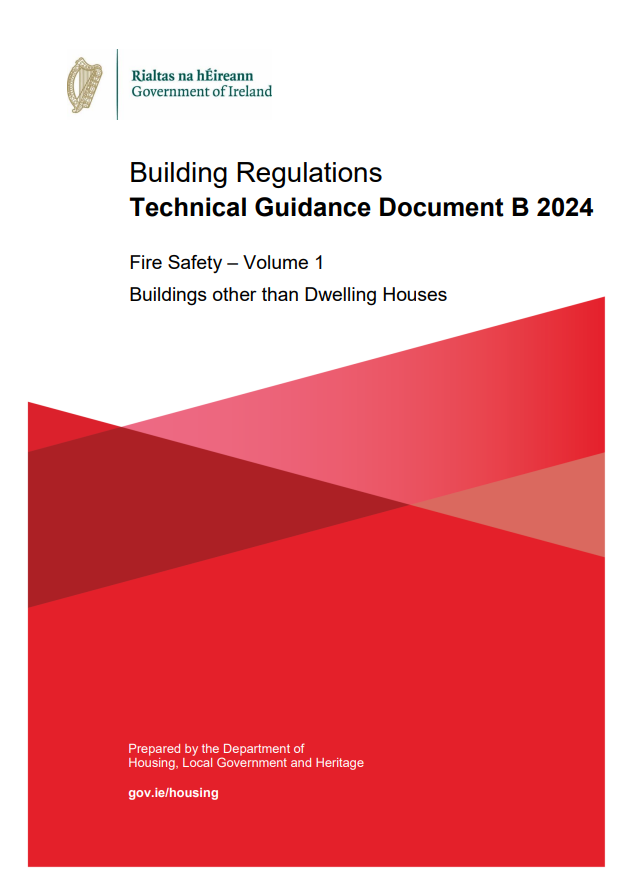
What Buildings Require a Fire Safety Certificate?
Generally, fire safety certification is required for:
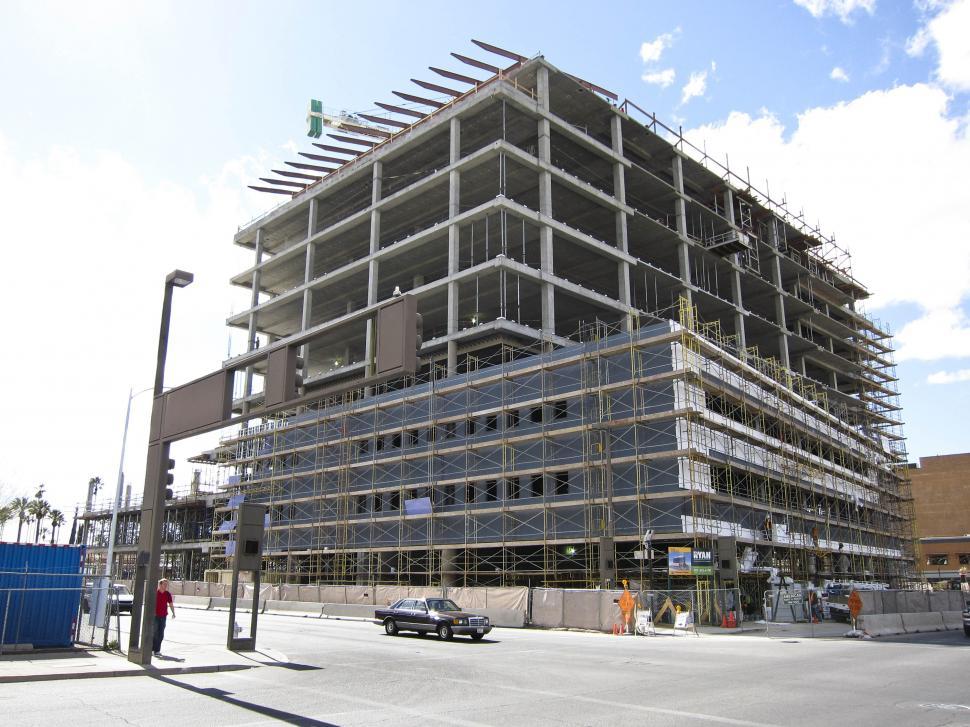
- The design and construction of a new building,
- Material alterations to (but not limited to), a day centre, flat or block of flats, hotel, hostel or guest building, a care facility building, place of assembly, shopping centre, a shop, office, or industrial building where additional floor area is provided or the building is being subdivided.
- An extension of a building by more than 25 square metres.
- A material change of use of a building.
There are certain instances where fire safety certification is not required, for example dwellings and certain agricultural buildings are exempt from the requirements. If you are unsure if your building or works requires fire safety certification, please contact Regent Fire Consultants today and we will be happy to advise.
What is Required to Obtain a Fire Safety Certificate?
The application is a technical process that is typically prepared by a qualified Fire Safety Consultant who has a sound knowledge of the Building Regulations and fire safety design. Applications are generally submitted online via the national Building Control Management System (BCMS) and must include:
- A completed application form.
- Relevant Drawings: To include plans, sections, elevations, site plan and OS Map showing the proposed fire safety design, including compartmentation, escape routes, fire-resistant construction, fire-fighting facilities, etc.
- A Fire Safety Strategy Report (or Compliance Report): A detailed report demonstrating how the proposed design complies with the functional requirements B1 to B5 and B12 of the Building Regulations. This often involves systematically addressing the requirements of Technical Guidance Document B, BS 9991, BS 9999 or other relevant fire safety guidance document.
- The Appropriate Fee: The fee is calculated based on the floor area to which the application relates, subject to statutory minimum and maximum amounts. Fees are typically as follows:
- Standard/Revised Fire Safety Certificate: €2.90 per square meter;
- 7 Day Notice Application: €5.80 per square meter;
- Regularisation Fire Safety Certificate: €11.60 per square meter.